
Real-time code collaboration tools solve the biggest challenges remote engineering teams face: time zone delays, slow feedback, and onboarding struggles. These tools let developers edit code together, debug issues live, and share environments instantly, cutting delays and boosting productivity.
Takeaways:
- Time zone delays: Pull requests take 2.5x longer in asynchronous workflows.
- Lost productivity: Context switching causes a 23% productivity drop.
- Faster onboarding: Pre-configured environments save weeks for new hires.
- AI assistance: Automates repetitive tasks, improving efficiency by up to 50%.
Hyperion360 simplifies remote work with pre-vetted engineers who integrate smoothly into your team. With real-time tools and skilled talent, remote teams deliver faster, reduce costs, and maintain high-quality code, no matter where they’re located.
Common Challenges for Remote Engineering Teams
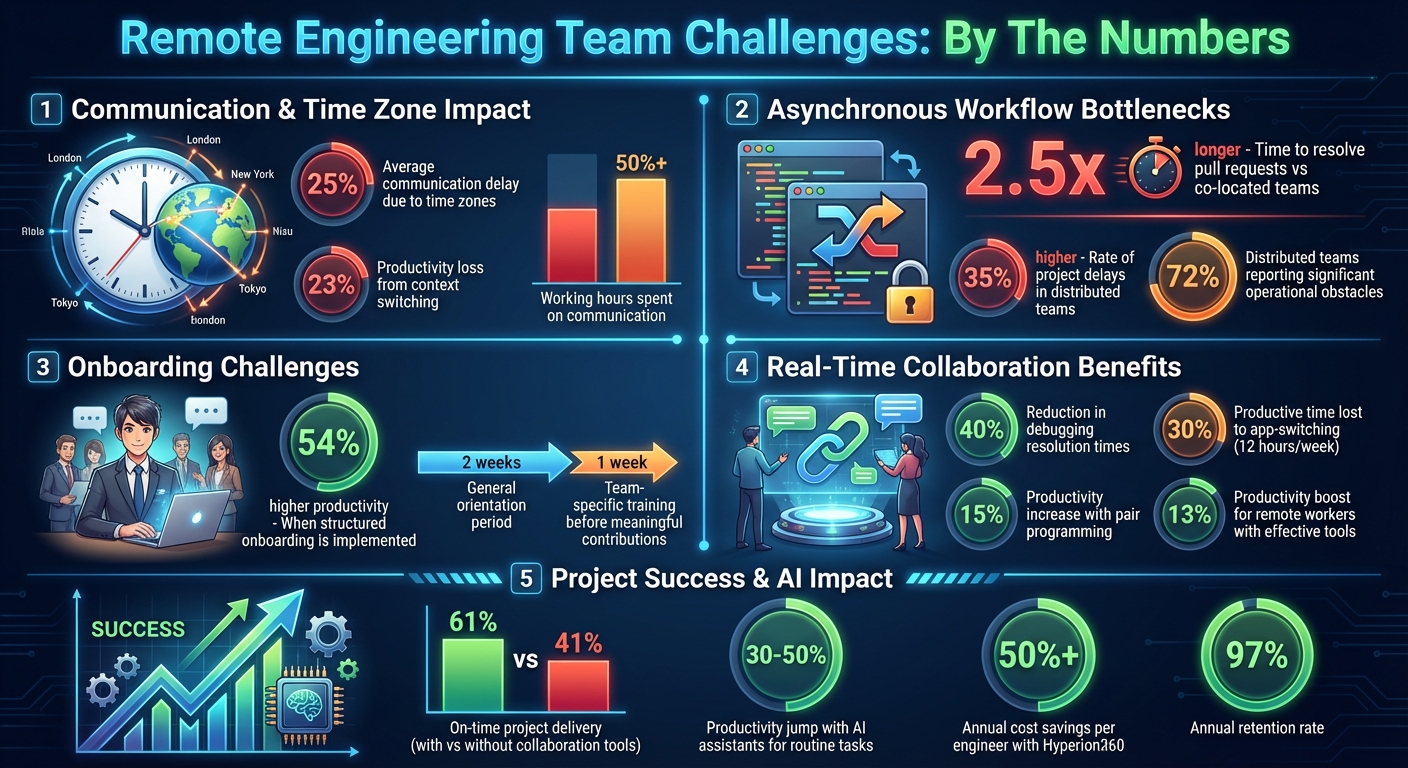
Remote work, while boosting productivity in many ways, also comes with its own set of challenges. For distributed engineering teams, the hurdles often boil down to three key areas: time zone differences, asynchronous workflows, and onboarding difficulties. These issues can lead to communication breakdowns, slower development cycles, and increased technical debt. Here is how these challenges affect remote teams.
Communication Delays and Time Zone Differences
Time zones can be a major roadblock for remote teams. Pull requests often sit untouched for hours, or even an entire day, waiting for reviewers in other time zones to come online. This lag creates an average 25% communication delay, making it harder to maintain momentum. Developers are forced into a frustrating cycle of switching between coding and checking tools like Slack or GitHub for updates. This constant task switching disrupts their focus, leading to a 23% loss in productivity as they struggle to regain the deep concentration needed for effective problem-solving.
Beyond delays, remote teams miss out on the spontaneous moments that happen naturally in an office. Quick questions, overheard conversations, or impromptu brainstorming sessions that might resolve an issue in minutes are harder to replicate remotely. Instead, team leads must actively ensure that important updates are shared, which can feel unnatural compared to organic in-person communication. To make matters worse, text-based communication lacks the nuance of body language and tone, increasing the chances of misunderstandings. With engineers spending over 50% of their working hours communicating, fragmented interactions across time zones can severely impact a team’s velocity.
Version Control Conflicts and Delayed Feedback
Asynchronous workflows also create bottlenecks in code reviews, slowing down development cycles. When team members aren’t online at the same time, pull requests take 2.5 times longer to resolve compared to teams working in the same location. This delay forces developers to shift their focus to other tasks while waiting for feedback, only to struggle with context switching when they return to the original code. The result? Lost momentum and reduced productivity.
Distributed teams also face a 35% higher rate of project delays compared to their co-located counterparts. Without real-time collaboration, simple mistakes can slip through multiple review rounds, and uncoordinated edits lead to frequent merge conflicts. A lack of visibility into what others are working on often results in duplicated efforts and avoidable code conflicts. These inefficiencies add up, creating operational challenges that 72% of distributed teams report as significant obstacles to their success.
Onboarding and Environment Setup Difficulties
For new remote hires, the onboarding process can be a steep uphill climb. Technical setup issues, like misconfigured environments or delayed equipment deliveries, often eat up valuable time, leaving new engineers troubleshooting instead of contributing. Unlike in-office settings, remote newcomers can’t rely on passive observation or quickly identify who to ask for help, which creates information silos and slows their progress.
Structured onboarding can make a difference, with companies reporting 54% higher productivity from new hires when they invest in clear processes. However, remote onboarding often stretches over several weeks, with two weeks typically dedicated to general orientation and another week for team-specific training before new hires can start making meaningful contributions. Switching between disconnected tools during this process only adds to the frustration, making it harder for new engineers to ramp up. Without intentional efforts to replicate the knowledge-sharing that happens naturally in offices, remote teams risk higher turnover and slower integration.
Understanding these challenges is an important step toward adopting tools and strategies that can help remote teams work more efficiently and stay connected.
Key Features of Real-Time Code Collaboration Tools
Real-time collaboration tools are designed to bridge the gaps caused by time zones and delayed feedback in remote work. By bringing immediacy and spontaneity to virtual teamwork, these platforms tackle the common hurdles of asynchronous workflows. Here are the standout features that make this possible.
Simultaneous Code Editing and Co-Development
With multi-cursor editing, developers can work together on the same file at the same time. Each person gets their own cursor, making it clear who’s working on what. This eliminates the delays of traditional version control and allows teams to solve problems collectively. Tools like Visual Studio Live Share and CodeTogether even support collaboration across different IDEs, such as VS Code and IntelliJ.
Adding to this is the focus and follow navigation feature. For instance, a senior developer can guide a junior team member through a tricky codebase by having them follow their cursor as they navigate files. This is especially helpful during code reviews or mentoring, where maintaining context is key. Built-in communication tools, like text chat, audio calls, and video conferencing, further simplify discussions, eliminating the need to switch between multiple apps.
Shared Debugging and Problem-Solving
Shared debugging tools allow teams to look at code execution together, viewing the same call stack, variables, and current state. With shared terminal access, teams can run commands and view outputs collaboratively, even if their local setups differ. This approach not only simplifies troubleshooting but can also reduce resolution times by up to 40%.
Environment Sharing and Faster Onboarding
Cloud-based environments such as GitHub Codespaces and Replit offer pre-configured workspaces that are ready to use immediately. This slashes onboarding time, provides benefits of staff augmentation for scaling teams, and eliminates setup inconsistencies. Everyone works with the same configuration, solving the classic "it works on my machine" issue. Shared servers and localhost access let mentors share terminal sessions, databases, or web apps with teammates securely, without exposing ports online. This means new engineers can start contributing sooner, boosting team efficiency.
Benefits of Using Real-Time Collaboration Tools
Real-time collaboration tools tackle common challenges while offering clear advantages for development teams.
Faster Development and Reduced Time-to-Market
With real-time collaboration tools, the delays of asynchronous code reviews become a thing of the past. Developers can work together instantly, cutting out the wait times that slow progress. Pair programming, for example, has been shown to increase productivity by 15%, and when paired with real-time tools, teams can deliver features more quickly. Collaborative debugging and terminal sharing allow issues to be resolved in minutes rather than lingering in review queues, keeping projects on track.
Better Team Alignment and Communication
By embedding communication directly into the IDE, real-time tools eliminate the need for constant app-switching, which often disrupts focus. Studies reveal that developers lose about 30% of their productive time, roughly 12 hours per week, due to context switching between applications. Real-time tools integrate text, voice, and video chat directly into the coding environment, keeping discussions tied to the code and reducing mental strain. Features like focus-and-follow enable senior developers to guide teammates through complex logic in real time, avoiding the need for separate meetings or lengthy written explanations. This smooth interaction ensures alignment without unnecessary friction.
Scalability for Distributed Teams
As remote work becomes increasingly common, real-time collaboration tools provide the foundation for globally distributed teams to thrive. Cloud-based setups ensure everyone works from the same configurations, removing the hassle of onboarding new team members across different regions. Research shows that remote workers equipped with effective tools are 13% more productive than those working in offices. These tools also offer secure, encrypted sessions with role-based access controls, making it easier to expand teams without being limited by geography or local hiring constraints.
How Hyperion360 Supports Remote Technical Teams

Building Dedicated Remote Teams
Hyperion360 offers full-time engineers who are exclusively dedicated to one client. These aren’t freelancers. They smoothly integrate into your team, participating in Slack channels, daily standups, and tools like Jira and GitHub. Essentially, they work as an extension of your in-house team, following your processes and directly reporting to your engineering leadership.
The hiring process is thorough. It starts with live screening calls to assess English proficiency, career trajectory, and technical reasoning. This is followed by live code walkthroughs and specific technical assessments. Engineers are matched to your technology stack, whether it’s React, Python, or Node.js, so they can hit the ground running without needing extensive training. With a 97% annual retention rate, these engineers become long-term contributors, gaining deep familiarity with your codebase and workflows. This setup ensures smooth collaboration and integration, even across time zones.
Enabling Real-Time Collaboration Across Time Zones
Time zone challenges can slow down remote teams, but Hyperion360 addresses this by sourcing engineers from regions like Latin America, Vietnam, Argentina, and Brazil. These locations provide a 4–8 hour overlap with U.S. business hours, ensuring real-time collaboration during critical periods.
This overlap allows engineers to actively participate in debugging sessions, pair programming, and code reviews, reducing the delays common in asynchronous setups. Since all engineers are vetted for English fluency, communication barriers are minimized, making it easier to resolve issues quickly. This synchronized approach helps simplify workflows and reduces operational inefficiencies.
Reducing Overhead with Pre-Vetted Talent
Hyperion360 simplifies hiring by delivering pre-vetted engineers who can start within 1–14 days. Each hire begins with a 30-day trial to ensure they’re the right fit for your team. Beyond recruitment, Hyperion360 takes care of HR, payroll, compliance, and legal responsibilities, freeing up your engineering leadership to focus on technical goals and strategy.
This approach is cost-effective too. Clients save over 50% annually per engineer compared to hiring locally in the U.S., without sacrificing quality. The pricing is straightforward. One flat monthly fee covers everything, including compensation, recruitment, HR, and compliance. There are no hidden fees or long-term commitments. By simplifying both hiring and operational management, Hyperion360 improves the efficiency of real-time collaboration.
"Not only do they produce exceptional work, they're quick, responsive, professional and extremely reliable." - Stan Chang, GM, Henkaa
Wrapping It Up
Remote engineering teams often grapple with hurdles like communication delays, version control issues, and the challenges of working across time zones. Real-time code collaboration tools tackle these head-on by enabling simultaneous editing, shared debugging, and consistent environments, putting an end to the dreaded "works on my machine" scenario. By collaborating in real time, developers shorten feedback loops from hours to mere minutes, speeding up the entire development process.
Data shows that teams using project management and collaboration tools deliver 61% of their projects on schedule, compared to only 41% for those without such tools. Add AI-powered assistants like GitHub Copilot into the mix, and productivity for routine coding tasks can jump by 30–50%, further amplifying the benefits of real-time collaboration.
But even the best tools need skilled engineers to get the most out of them. That’s where Hyperion360 steps in. They provide pre-vetted, full-time engineers who smoothly integrate into your team. These aren’t freelancers juggling multiple gigs. They’re dedicated professionals working in your time zone, attending your standups, and using your tools. Over time, they become deeply familiar with your codebase and workflows, functioning as true team members.
The combination of modern tools and top-tier talent gives teams the ability to operate with the immediacy of an in-office setup, while still enjoying the cost savings and global reach of a distributed model. Companies adopting this approach often cut overhead by more than 50% per engineer without compromising on code quality or delivery timelines.
Whether you’re scaling up a startup or running large-scale enterprise projects, the solution is clear: invest in real-time collaboration tools and build teams that can fully use them. The technology is ready. The talent is available. Now it’s time to bring it all together.
Frequently Asked Questions
Which teams benefit most from real-time code collaboration?
How do real-time sessions stay secure with shared terminals and environments?
What should we change in our workflow to adopt real-time collaboration?
To make real-time collaboration work, focus on tools that bring everything together: communication, code reviews, and teamwork. Look for platforms that allow your team to interact effortlessly while keeping everything in one place.
Incorporating AI-powered features can make a big difference. These tools can automate repetitive tasks like code reviews, speed up workflows, and cut down on delays caused by waiting for responses in asynchronous setups.
At the same time, don’t forget about team members working across different time zones. Supporting asynchronous workflows ensures everyone stays productive without sacrificing code quality. By using these tools consistently, you’ll reduce the need for constant context switching, making it easier for your team to stay in sync.
Comments