
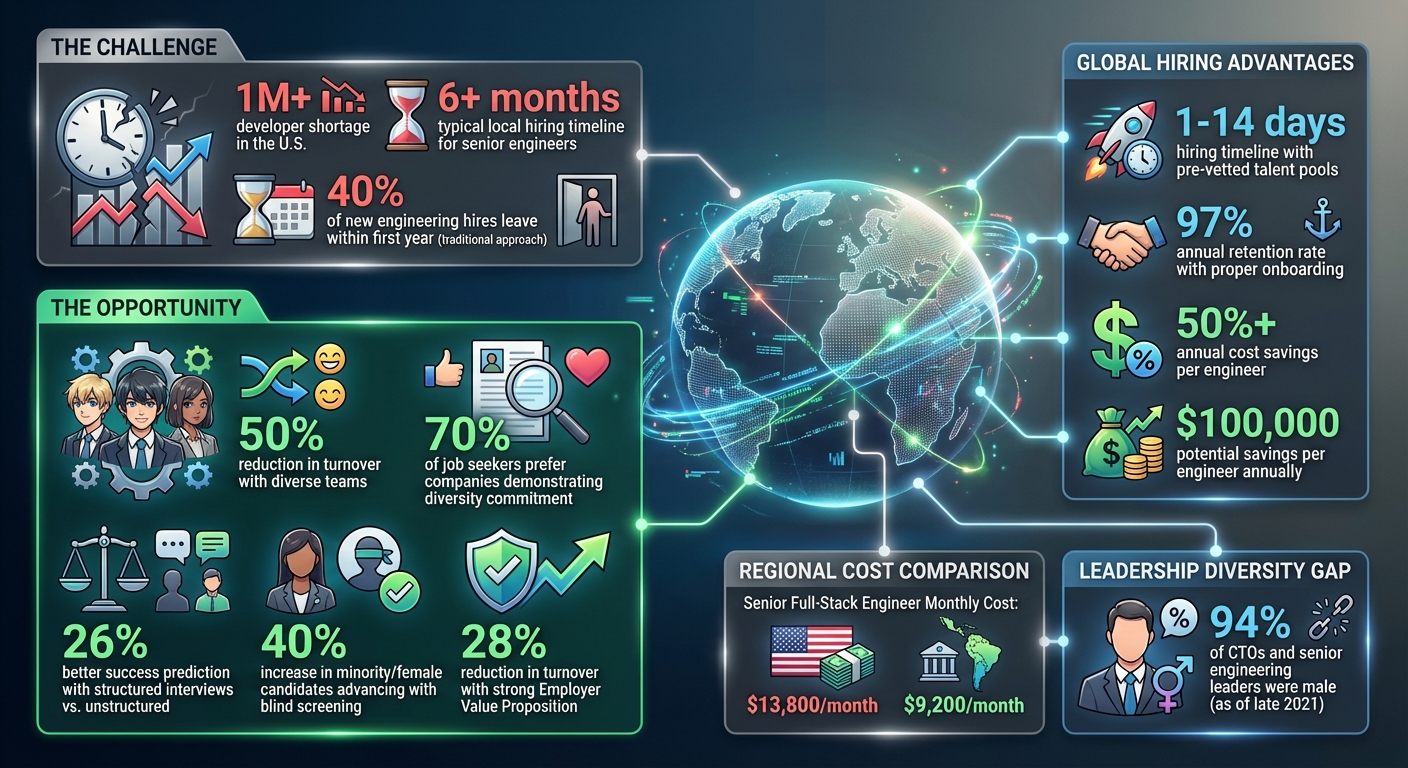
- Why it matters: Diverse teams cut turnover by 50% and bring perspectives that create solutions for broader markets. With over 1M developer shortages in the U.S., global hiring is no longer optional. It's necessary.
- Global hiring advantage: Hiring locally takes 6+ months. Nearshoring to regions like Latin America offers faster timelines, cost savings, and overlapping time zones.
- Key steps:
- Write clear, bias-free job descriptions by separating "must-have" and "nice-to-have" qualifications.
- Show your diversity commitment with real team stories, measurable goals, and inclusive policies.
- Target global talent hubs like Latin America (real-time collaboration), Eastern Europe (backend systems), and Asia (AI/ML expertise).
- Use vetted remote software engineers to cut hiring time to 1–14 days and simplify compliance.
- Standardize technical assessments and use structured interviews to reduce bias.
- Onboard effectively with clear goals, mentors, and tools to integrate global hires smoothly.
Bottom line: Building global engineering teams is about more than filling roles. It’s about accessing top talent, improving retention, and scaling efficiently. Hyperion360 simplifies this with pre-vetted talent and global HR solutions, saving time and money while ensuring long-term team success.
Your job descriptions and employer brand often serve as the first interaction potential candidates have with your company. If your postings are packed with jargon or vague qualifications, you risk losing great engineers before they even consider applying. The key is to strike a balance: clearly outline what you need while highlighting that your company values diverse perspectives and builds an inclusive environment. The strategies below will help you craft job descriptions that resonate globally and show your genuine commitment to diversity.
Removing Bias from Job Descriptions
Biased language can discourage qualified candidates from applying, even when they meet most of the requirements. To address this, start by distinguishing essential qualifications from preferred ones. Research shows that many engineers, especially women and individuals from underrepresented groups, only apply when they meet every listed qualification. By clearly separating must-haves from nice-to-haves, you open the door to a wider pool of talent.
Stick to gender-neutral language in your postings. Words like leading, building, and developing are more inclusive than terms that may unintentionally favor a specific gender. Focus on the responsibilities and growth opportunities rather than buzzwords that might not translate well globally. For instance, instead of saying you’re looking for someone who thrives in a fast-moving, competitive environment, describe the work itself: You’ll ship features weekly and collaborate with product teams to solve complex technical challenges.
Also, set clear communication expectations. Offer written interview questions and provide flexible interview slots that accommodate different time zones. If language proficiency is important, highlight regions with strong English skills to ensure clarity without alienating candidates.
These steps ensure your job postings attract diverse talent while reflecting your commitment to inclusivity.
Demonstrating Your Company Culture and Diversity Values
Candidates want more than a generic diversity statement. They want proof. In fact, 70% of job seekers prefer companies that actively demonstrate a commitment to diversity. Authentic representation is key. Use real team photos and testimonials on your website and social platforms. These visuals help candidates envision themselves as part of your organization.
Storytelling is much more effective than corporate jargon. A 2023 podcast featuring a prominent CEO emphasized how diversity at the leadership level drives engagement and innovation. Share stories about your diverse engineers and leaders through blog posts, videos, or testimonials. Highlighting senior leaders from underrepresented groups sends a strong message. For example, as of late 2021, 94% of CTOs and senior engineering leaders were male, making it even more impactful to show diverse leadership.
Be transparent about your diversity goals and progress. Share measurable targets and updates regularly. For example, in May 2021, Twitter committed to a workforce that is at least 50% women globally and at least 25% underrepresented minorities in the U.S. by 2025. They backed this up by promoting leaders like Nick Caldwell (VP of Consumer Engineering), demonstrating real progress.
Finally, highlight benefits and policies that appeal to global talent. Mention Employee Resource Groups with dedicated funding, formal mentorship programs (which improve promotion and retention rates for women and minorities), and flexible remote work options. Tailor your messaging to reflect what matters most in the regions you’re targeting, whether that’s professional growth, work-life balance, or something else entirely. These details show candidates that your company is a place where they can succeed and thrive.
Finding Talent in Global Engineering Hubs
After perfecting your job descriptions and solidifying your employer brand, the next challenge is figuring out where to find skilled engineering talent. With the U.S. facing a developer shortage of over 1 million, it's clear that companies need to look beyond their borders. Fortunately, there are several global regions brimming with talented engineers ready to collaborate with U.S. businesses, often at lower costs. This global approach complements your inclusive employer branding by targeting areas where expertise and affordability intersect.
High-Potential Regions for Engineering Talent
Once your inclusive job postings are live, the next step is identifying regions with strong talent pools. Each area offers unique advantages:
Latin America: Known for full-stack development, mobile engineering, and real-time collaboration, this region is a top choice. Countries like Argentina and Brazil share overlapping time zones with the U.S., making teamwork smooth. English proficiency is generally strong, and the cost savings are notable. For example, hiring a senior full-stack engineer in Latin America costs about $9,200/month compared to $13,800 in the U.S.
Eastern Europe: This region shines in fintech, backend systems, and complex architecture. While time zone overlap is partial, the area's strong technical education and high English proficiency make it a dependable option.
South and East Asia: Countries such as Vietnam are emerging leaders in AI/ML, QA automation, and data science. While time zone alignment with the U.S. is limited, the technical expertise, especially in machine learning and quality assurance, is exceptional. English proficiency varies, so assessing communication skills is essential.
Each region brings distinct strengths, allowing you to build diverse teams tailored to your needs. Latin America is ideal for real-time collaboration, while Eastern Europe and Asia excel in specialized technical skills at competitive rates. Understanding these regional differences ensures you're targeting the right talent for your goals.
Using Pre-Vetted Talent Pools
Sifting through resumes and conducting interviews manually is time-consuming and inefficient. Pre-vetted talent pools simplify this process by connecting you with engineers who are already evaluated for technical skills, English proficiency, and professionalism. By partnering with global staffing firms like Hyperion360, companies can drastically cut hiring timelines, from the usual 6+ months for senior engineers to just 1–14 days, while maintaining a 97% annual retention rate.
These pre-vetted pools go beyond basic screening. They rigorously test candidates for technical expertise, communication, and cultural fit, ensuring you're only meeting individuals who are ready to contribute immediately. Eddie Lin, CEO of NexusEdge, highlighted this benefit:
Hyperion360's team of world-class developers quickly executes on building scalable, high-performing technology.
Beyond saving time, pre-vetted pools offer flexibility. Many firms include a 30-day trial period, allowing you to assess fit in a real-world context before making a long-term commitment. They also handle complex administrative tasks like payroll, compliance, benefits, and taxes through Employer of Record (EOR) services. This is especially useful when hiring across multiple countries, as it ensures consistency and reduces administrative burdens.
Creating Fair and Effective Vetting Processes
After identifying promising talent pools, the next challenge is evaluating candidates in a way that’s both fair and effective. A well-structured vetting process minimizes bias and ensures you’re bringing in top performers. Research highlights that structured interviews outperform unstructured ones by 26% for predicting success, offering a more objective way to make hiring decisions. The secret lies in standardizing how you assess both technical skills and communication abilities, ensuring every candidate gets a level playing field.
Using Consistent Technical Assessments
Standardized technical assessments provide a solid foundation for unbiased candidate evaluation. By using the same coding tests, live problem-solving exercises, and portfolio reviews for all applicants, and scoring them against a clear rubric, you significantly reduce subjectivity. Blind screening can further help by removing details like names, gender, age, or educational background from initial evaluations. This approach can increase the likelihood of minority and female candidates advancing to first-round interviews by about 40%. Guillermo Solano-Flores, a Professor of Education at Stanford University, explains:
Bias affects testing whenever diverse student populations are assessed. It occurs when we see systematic score differences between student groups that stem from factors unrelated to the knowledge or skills being measured.
To ensure fairness, avoid assessment scenarios that rely on specific cultural or socioeconomic knowledge. For instance, analogies involving niche hobbies or activities can unintentionally exclude underrepresented groups. Keep instructions straightforward and free of idioms or colloquialisms so candidates are judged purely on their skills. Regularly audit hiring data to identify demographic performance gaps, and train interviewers to recognize and counter biases like affinity bias or confirmation bias.
Evaluating Communication and Collaboration Skills
For assessing communication and collaboration, a thoughtful approach is essential. For global engineering teams, factors like English proficiency, time zone compatibility, and work style alignment matter, but you need to avoid introducing new biases in the process. Instead of relying on vague notions of "cultural fit", focus on practical collaboration scenarios that reflect real-world tasks.
One effective strategy is implementing a trial period with clear, measurable goals. This allows you to evaluate a candidate’s real-world performance without the pressure of committing to a long-term hire right away. Jon O'Bryan, CEO of Atlas Inc, sums it up well:
The mental shift here is that if the candidate doesn't work out, instead of firing them, you're just not hiring them.
Onboarding and Retaining Global Engineers
Getting global engineers onboarded and keeping them engaged takes careful planning. It’s not just about hiring; it’s about making them feel like an integral part of the team. Companies that get this right enjoy retention rates as high as 97% annually, while more traditional hiring approaches see nearly 40% of new engineering hires leave within their first year.
Onboarding Remote Engineers Successfully
The first 30 days matter most. A well-structured onboarding plan sets the tone for success. Start by ensuring new engineers have everything they need from day one: tools like Slack, project management software, code repositories, and any other company-specific platforms. Pair them with a dedicated mentor, ideally a senior engineer or technical lead, to guide them through team dynamics, coding standards, and any questions they might have. This is especially helpful for junior engineers adjusting to new environments.
Set clear, achievable goals for the first month. These could include completing specific tasks, participating in code reviews, or even shipping a small feature. Treat this period as a fully paid trial, focusing on both technical skills and team fit before transitioning to a long-term role. Don’t skip essential steps like cybersecurity training and signing non-disclosure and intellectual property agreements to safeguard your company’s assets.
Time zone compatibility matters, too. Aim for at least four to eight hours of overlap to allow real-time collaboration during standups, sprint planning, or other team meetings. This ensures global engineers feel connected and part of the workflow. To handle local employment laws, taxes, and benefits, consider using Employer of Record services. These services not only simplify compliance but also provide financial stability, which is key to building trust and long-term commitment.
Once engineers are fully onboarded, the next challenge is keeping them engaged and motivated.
Creating Retention Programs for Global Talent
Retention starts with treating global engineers as core members of the team. A strong Employer Value Proposition can reduce turnover by 28%, and this applies to distributed teams as much as local ones. Offer clear career growth opportunities, regular performance reviews, and chances to take on more responsibility. This reinforces your commitment to inclusivity and diversity from day one. Edmond Roche, CEO of DMN8, summed it up perfectly:
Finding and activating talented technical staff is efficient, the developers have been effective and wonderful to work with... I'll continue to work with Hyperion developers for the rest of my career.
Celebrate achievements, no matter how remote the team member is. Publicly recognize wins in team channels, allocate budgets for professional development like certifications or courses, and create pathways for career advancement into senior or leadership roles. Reliable financial practices are just as important, on-time monthly payments and transparent pricing models eliminate unnecessary stress and build trust. When engineers feel appreciated and see a future with your company, they’re more likely to stay. Daniel Broukhim, CEO of FabFitFun, put it this way:
Hyperion360 has been a true pleasure to work with. They are more than just a firm but also a partner.
Conclusion
Bringing in diverse engineering talent from around the world takes a well-organized strategy. The most successful companies treat global engineers as integral team members from day one.
The results speak for themselves. With vetted global talent, onboarding can take as little as 1–14 days, compared to the drawn-out 6+ month hiring cycles. This simplified process can save over 50% annually per engineer, sometimes cutting costs by as much as $100,000, all while maintaining an impressive 97% retention rate.
Hyperion360 makes this process smooth. They manage recruiting, HR, legal, global payroll and compliance across more than 100 countries. Every engineer is pre-vetted for technical skills, English proficiency, and professional conduct, so you can focus on integrating them as full-time team members who align with your time zone.
Eddie Lin, CEO of NexusEdge, shared his experience:
Hyperion360's team of world-class developers quickly executes on building scalable, high-performing technology. We look forward to our continued growth with them at our side.
Stan Chang, GM at Henkaa, added:
We've been beyond ecstatic with the Hyperion360 team. Not only do they produce exceptional work, they're quick, responsive, professional and extremely reliable.
Building global engineering teams isn’t just about filling roles. It’s about gaining a competitive edge. It allows you to move faster, create better products, and scale more efficiently. With Hyperion360’s thorough approach, you can tap into world-class talent while cutting hiring costs, all while building a diverse and dynamic engineering culture.
FAQs
What are the key technical skills for remote engineers in 2026?
In 2026, being a successful remote software engineer means having a solid grasp of programming languages like Java, Python, and JavaScript, along with expertise in frameworks such as React, Angular, and .NET. Knowledge of version control tools like Git, as well as experience with cloud platforms and automation technologies, is just as important for staying competitive.
However, technical know-how isn’t the whole story. Strong communication skills are important for working effectively across different time zones, especially when using tools designed for asynchronous communication and project management. On top of that, the ability to manage yourself and adapt to changing circumstances will continue to be key traits for thriving in remote roles.
How do remote engineers avoid blockers with async communication?
Remote engineers can sidestep communication hurdles by crafting messages that are clear and detailed enough to eliminate the need for follow-ups. Including all necessary context upfront ensures teammates can act without confusion. To make information easier to digest, structure messages with bullet points or headers, allowing key details to stand out.
Choosing the right communication tool also plays a big role. For instance, use documentation platforms to tackle complex topics that require depth, while reserving chat tools for quick updates or simple questions. Finally, setting clear expectations, like defining timelines and deliverables, helps avoid misunderstandings and keeps everyone on the same page.
What security habits should remote engineers follow daily?
Remote engineers need to prioritize security by adopting smart, everyday habits. Start with strong, unique passwords for all accounts and manage them using a password manager. Always enable multi-factor authentication (MFA) for an added layer of protection. Keep your devices and software updated to guard against vulnerabilities.
For networks, stick to encrypted Wi-Fi and use a VPN to secure your connection, especially on public networks. Be vigilant against phishing attempts and social engineering tactics. If something feels off, trust your instincts and verify before acting.
Finally, make security training a regular part of your routine. Stay informed about the latest threats and follow clear data handling policies to ensure a safe and secure remote work environment. Small, consistent actions can make a big difference.
Comments